
Wingman Offers
A hospitality platform connecting venues with customers through digital vouchers and offers. Mobile app for diners, dedicated portals for administrators and venue operators.
Retail · 2024
iOS · Android · Web
HHIC runs Benchmark, the UK checklist for commissioning and servicing domestic heating and hot water. Work on the platform has been ongoing since 2020. It covers installer and homeowner apps, a web portal, manufacturer and MCS APIs, and Bluetooth flue-gas readings. The Google Play figure for the installer app is past 5,000 downloads, and a further release went out in September 2026.
For Heating and Hotwater Industry Council
Benchmark is how a UK heating engineer records the commissioning of a domestic heating or hot water system, and how they record a later service. The Heating and Hotwater Industry Council, usually shortened to HHIC, operates the scheme. From 1999, Benchmark has been a recognised route to showing Building Regulations compliance. Those regulations are the UK rules for building work, and they cover the way a home's heating is installed.
The checklist spent most of its life on paper. An engineer filled the form in by hand and gave it to the householder. There was nowhere that held, together, the appliance, the visit, and the engineer. HHIC asked for a record that could be finished at the property, retrieved later by the homeowner, and opened by a manufacturer.
Boilers were the original appliance. Heat pumps are on the scheme now, as are cylinders that store hot water, and heat interface units. The forms differ by appliance. A number of them run past 100 fields. Filling one in often means a loft or a plant room, and the signal there is frequently poor. The right model also has to be found in a list of thousands. A route in was required for manufacturers, for the installer apps those manufacturers already ship, for firms that employ installers, and for MCS. MCS is the UK scheme that certifies installations of heat pumps. The record itself has to stay correct, and still be readable, across the years the appliance remains in use.
Digital Benchmark was first built in 2020. Development has continued from then. During 2022 the platform was rebuilt, and that rebuild is what let appliance types beyond the original set be added.
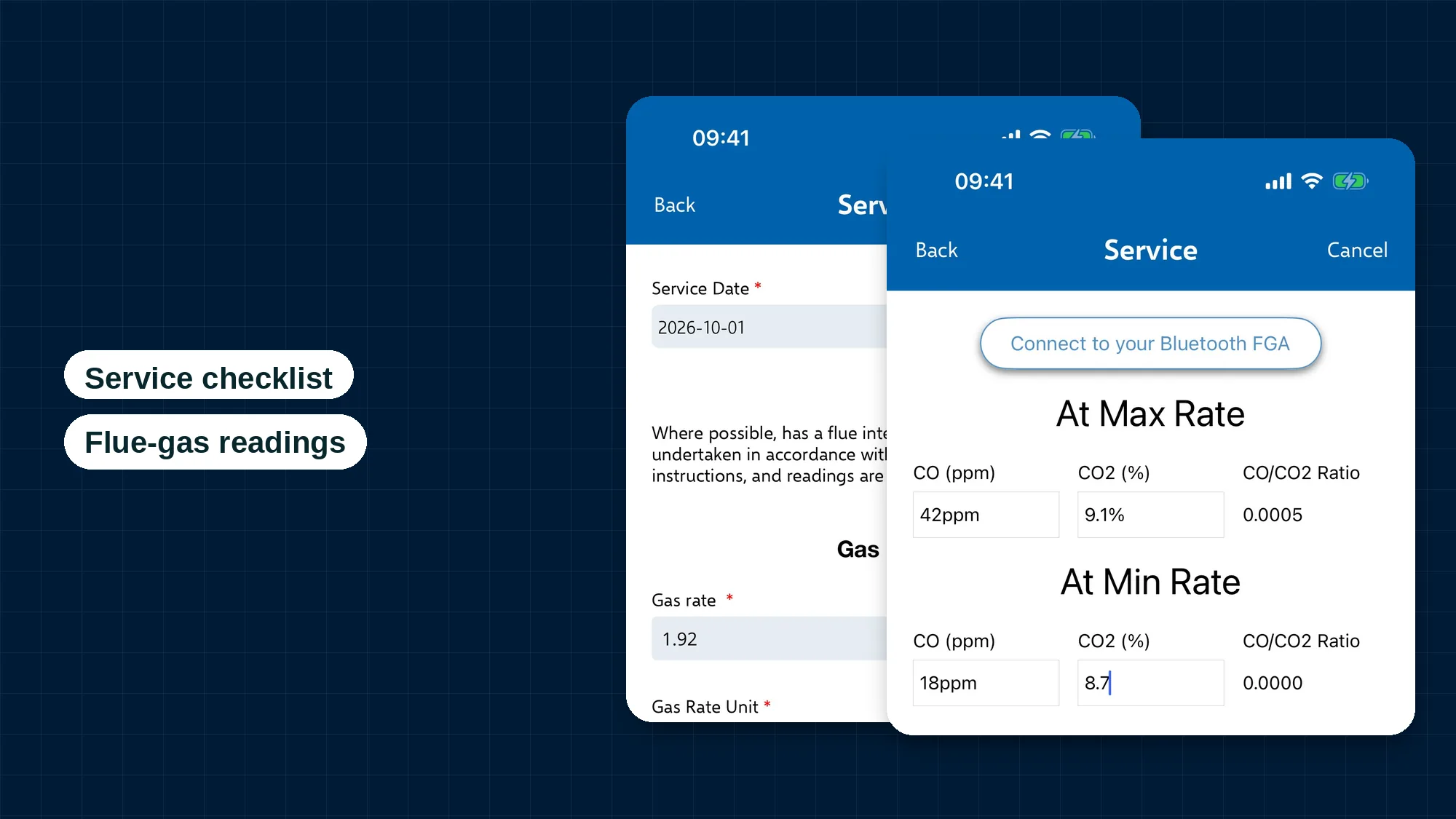
Installers have a native iOS app and a native Android app. Homeowners have the same pair. On the installer's phone a commissioning form or a service form can be completed, saved unfinished, and given photos. The engineer signs, and the customer signs. Point the camera at the appliance and it reads the serial number. That number is tested against the pattern the brand uses. A Bluetooth flue-gas analyser can push its readings into the form fields. The phone holds the brand and model catalogue and refreshes it behind the screen the engineer is using. Model search reads that on-phone catalogue.
A homeowner searches with a serial number plus a postcode. Installation history and service history are both there. The reminder that a yearly service is due can be a push notification, a text message, or an email.
Checklists are authored once, as data. That data is what the two phone apps, the website, the server checks, the PDF certificate, and the manufacturer-facing form layout all follow. Another appliance is another set of data. Staff who administer the portal can change those definitions there.
Inside the portal, installers have their own area. Firms that employ them have one. Manufacturers have one. Customer service has one. HHIC has one. A firm can invite its engineers, and it can see the installations those engineers have filed.
An API lets a manufacturer retrieve installations, services, and certificates. The manufacturer's own app can pass a job into Benchmark. Baxi's Toolbelt app gained that handoff in 2021. Beginning in 2023, commissioning records for heat pumps have been forwarded to the database MCS keeps of installations. MCS said the connection would help about 1,700 contractors certified for heat pump work.
March 2021 is when the installer app first reached users. The Google Play count for it is above 5,000 downloads. A further release of the same app went out in September 2026. Boilers were the start. The record now includes heat pumps. It also includes hot water systems, plus the links to MCS and to manufacturers.
An Australian industry body, or a manufacturer that runs its own installer scheme, can face the same site: a long form, a connection that fails in a plant room, a model list too long to browse, and a certificate someone will need to read years later. The decision that matters here is the single definition. Phones, portal, PDF, and API all read it, and a manufacturer's app can pass the job in. HHIC is a council in the UK. The building rules in this case study are the British Building Regulations.
Installer and homeowner apps sit with Mobile App Development. The portal, the shared definition, and the manufacturer API sit with Web Application Development.
A hospitality platform connecting venues with customers through digital vouchers and offers. Mobile app for diners, dedicated portals for administrators and venue operators.
Retail · 2024
iOS · Android · Web

An interactive iOS and Android experience for the UN Refugee Agency. Simulates refugee journeys through story-driven episodes designed to build empathy and drive donations.
Charity and Non-profit · 2024
iOS · Android

Tidy is a mobile app for construction and utilities field workers. Appoly built native iOS and Android apps with offline-first sync and a hardware-aware UI.
Construction & Utilities · 2023
iOS · Android